
How I Made Claude My GTM Mastermind?
Stop using AI as a search engine. Start using it as a strategy partner.

Most B2B founders use Claude the same way they use Google.
One question. One answer. Close the tab.
That’s not a GTM strategy. That’s a very fast way to get very generic advice.
The real shift happens when you stop treating Claude as a tool and start treating it as a system. One with memory, context, and the full weight of your hard-won GTM knowledge behind every single prompt.
Here’s how I built that system. And what it actually produces.
First, Understand Why Generic AI Fails at GTM
Go-to-market strategy is not a knowledge problem. It’s a context problem.
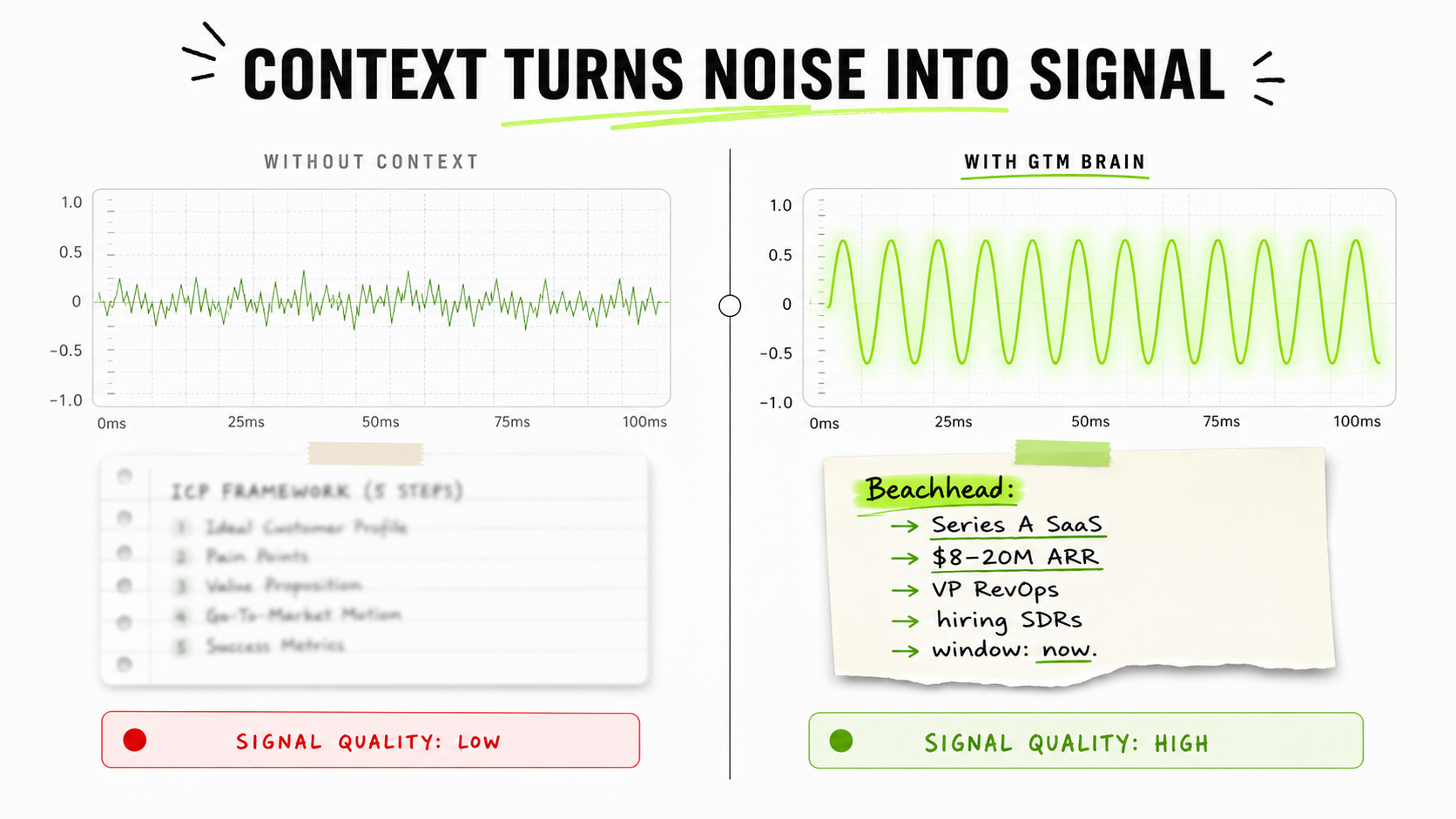
Ask Claude, “how do I find my ICP?” without any context, and you’ll get a five-step framework that reads like a HubSpot blog post from 2019.
Ask it the same question but with your customer discovery transcripts, your beachhead segment hypothesis, your competitor positioning map, and your current messaging loaded in? Different conversation entirely.
The quality of AI output in GTM work is directly proportional to the quality of context you give it. Garbage in, garbage out. This is the first thing most founders get wrong.
The GTM Brain: What I Actually Built
I spent months collecting the raw material. 113 GTM frameworks. 84 stage-specific AI prompts. Real client transcripts pulled from Fireflies. Case studies from Clay, Wiz, Cursor, Canva, and Superhuman. My own playbooks, positioning work, and client deliverables.
All of it lives inside a Claude Project I call the GTM Brain.
The concept is simple. Before I answer any strategic question for a client, before I write a single line of outbound copy, before I build a positioning argument, I search that project first. Claude responds not with internet generalities but with frameworks I’ve already stress-tested with real B2B SaaS companies.
That’s not AI as a copilot. That’s AI as a practitioner.
The 7 Jobs Claude Now Does
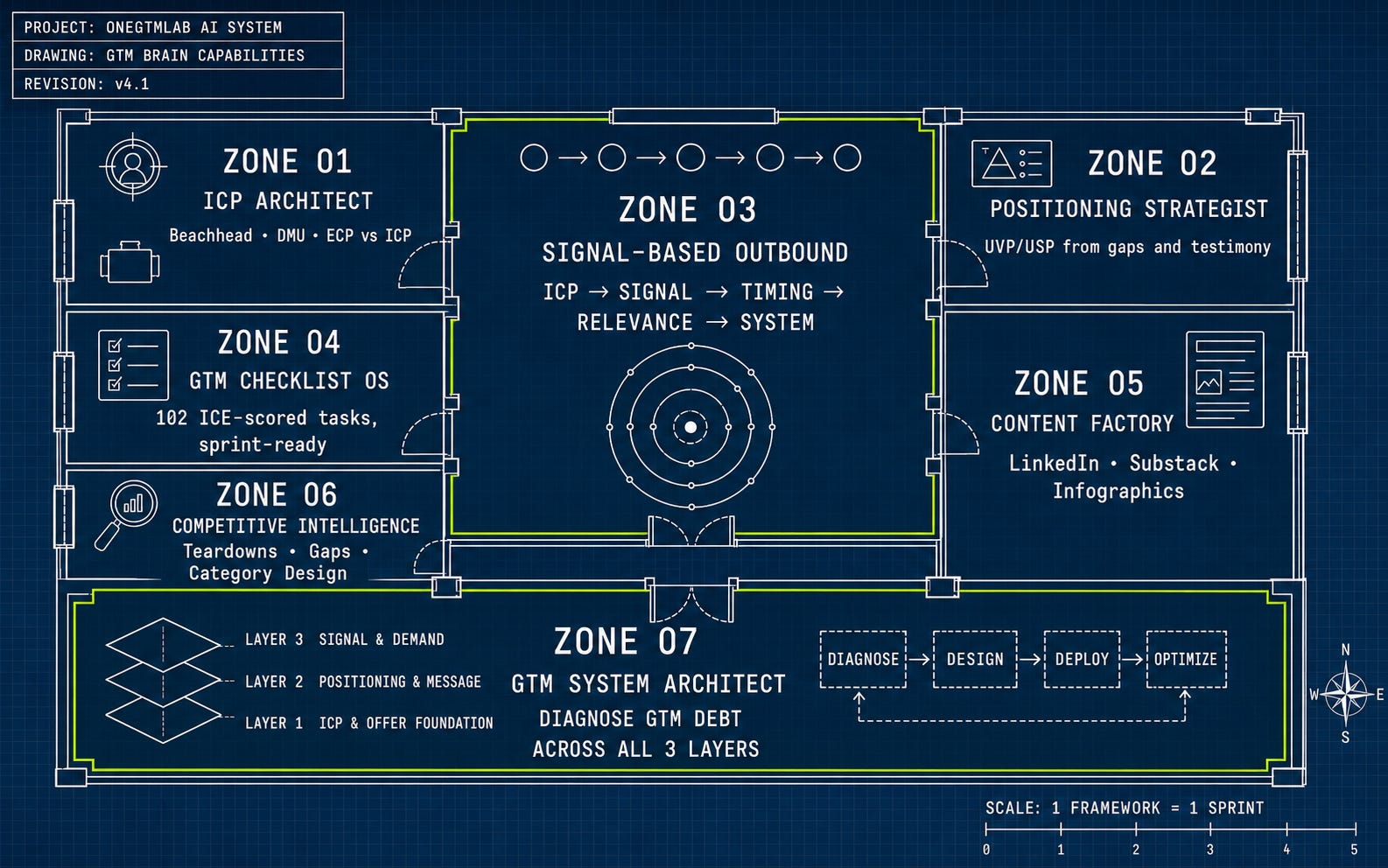
1. ICP Architect.
Not persona templates. Real beachhead segmentation using the Early Customer Profile vs ICP distinction, the Decision Making Unit framework, and the Market-Problem Map. Three workshops compressed into ninety minutes.
2. Positioning Strategist.
Claude can map competitive alternatives through the ICP’s actual lens, not your assumptions. It builds the first UVP/USP hypothesis using customer testimony language. It stress-tests every positioning angle before I take it to a client.
3. Signal-Based Outbound Engineer.
The old playbook was List, Sequence, Hope. The new one is ICP, Signals, Timing, Relevance, System. Claude helps me identify the right signal tier for each buyer profile, write signal-triggered sequences, and build the enrichment logic inside Clay.
I used this exact setup for an Anervea outbound campaign targeting biopharma CROs. Signals were FDA submission announcements and pipeline expansion news. Claude built the full sequence logic in a single session.
4. GTM Checklist OS.
There are 102 structured GTM tasks inside the Brain, each with an ICE score (Impact, Confidence, Ease), a stage tag, and a matching AI prompt. When a founder asks what to focus on at $2M ARR, Claude pulls from the actual task database. Not a vague framework. A prioritized 30-day sprint.
5. Content Factory.
Every Substack article, LinkedIn post, and infographic I publish runs through this system. The research comes from real case studies. The voice stays direct and operational. Each piece passes a simple test before it goes out: can a reader act on this today without hiring anyone? If not, it goes back into drafts.
6. Competitive Intelligence Engine.
Competitor positioning audits, messaging teardowns, pricing gap analysis. For Vorlon, Claude identified the white space between eight agentic security vendors and helped define an entirely new category called Agentic Ecosystem Security. Zero additional research cost. Two hours of work.
7. GTM System Architect.
The 3-Layer GTM System I use across every engagement (Product Marketing, Context Engineering, GTM Engineering) is fully codified. Claude diagnoses which layer is broken, designs the right motion for each ICP, and builds the OKR structure to execute against it.
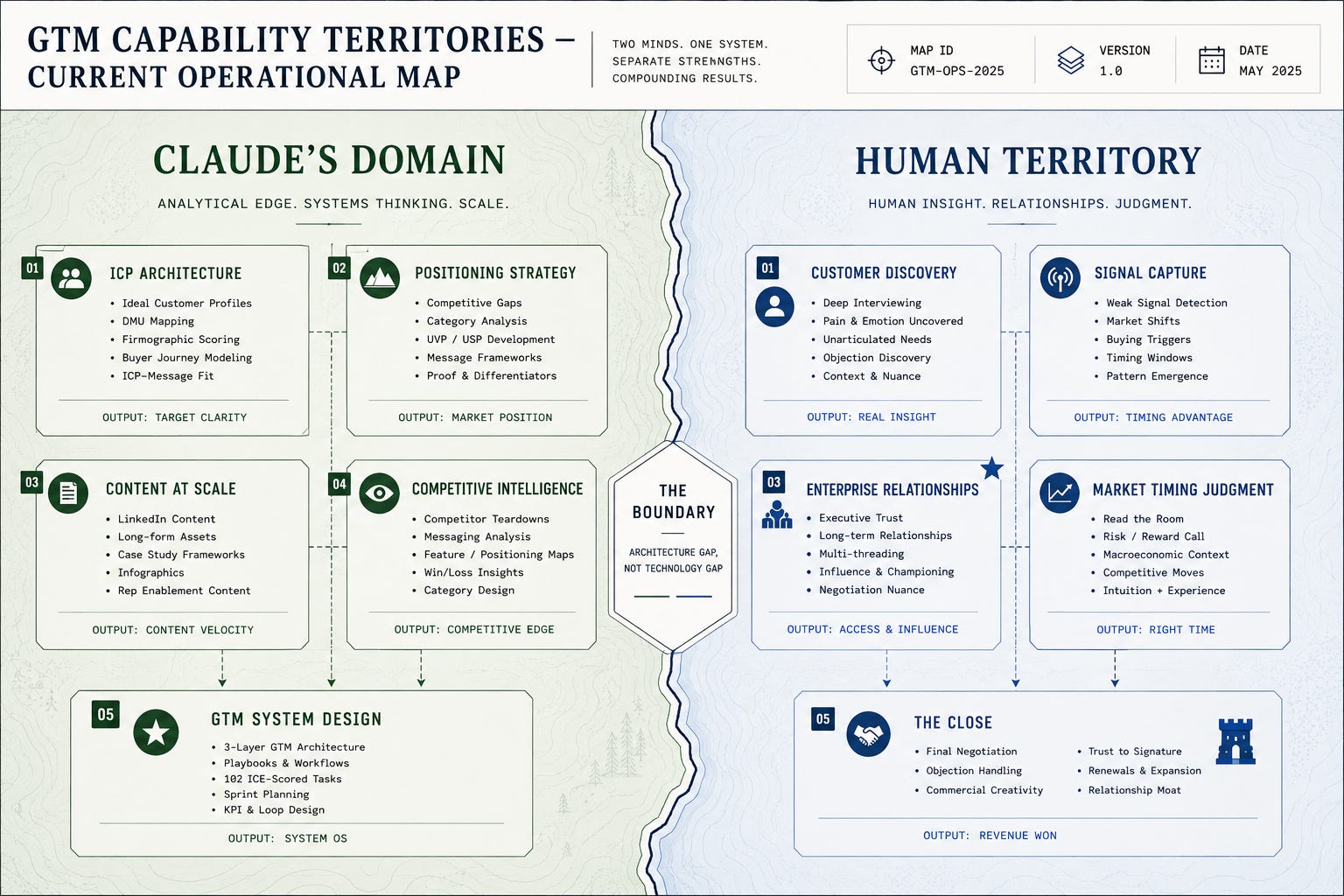
What Claude Still Cannot Do
Be honest about the edges.
↳ Claude cannot replace first-party signal data. You still need Clay, Bombora, UserGems, or Common Room for that. Claude tells you what signals to look for. The stack captures them.
↳Claude cannot replace 20 real customer discovery conversations. The prompts help you design better questions and analyze transcripts. They do not replace listening.
↳And Claude cannot build the relationships that close enterprise deals. The warm intro, the champion, the trusted referral. Those are still human jobs.
The One Thing Worth Remembering
Most founders use Claude as a faster search engine. A handful use it as an operating system with institutional memory.
The gap between those two approaches is not a technology gap. It’s an architecture gap.
Build the Brain first. Then ask the questions.
If this made you think differently about how you use AI in your GTM work, I write about GTM engineering, signal-based outbound, and what actually moves pipeline for B2B SaaS founders every week.
Subscribe below. Or reply with the one GTM job you’d most want Claude to take off your plate. I read every one.