
I audited a Series A GTM stack. Here's what was actually working.
What 22 tools, $30K a month, and zero signal architecture taught me about Series A pipeline.

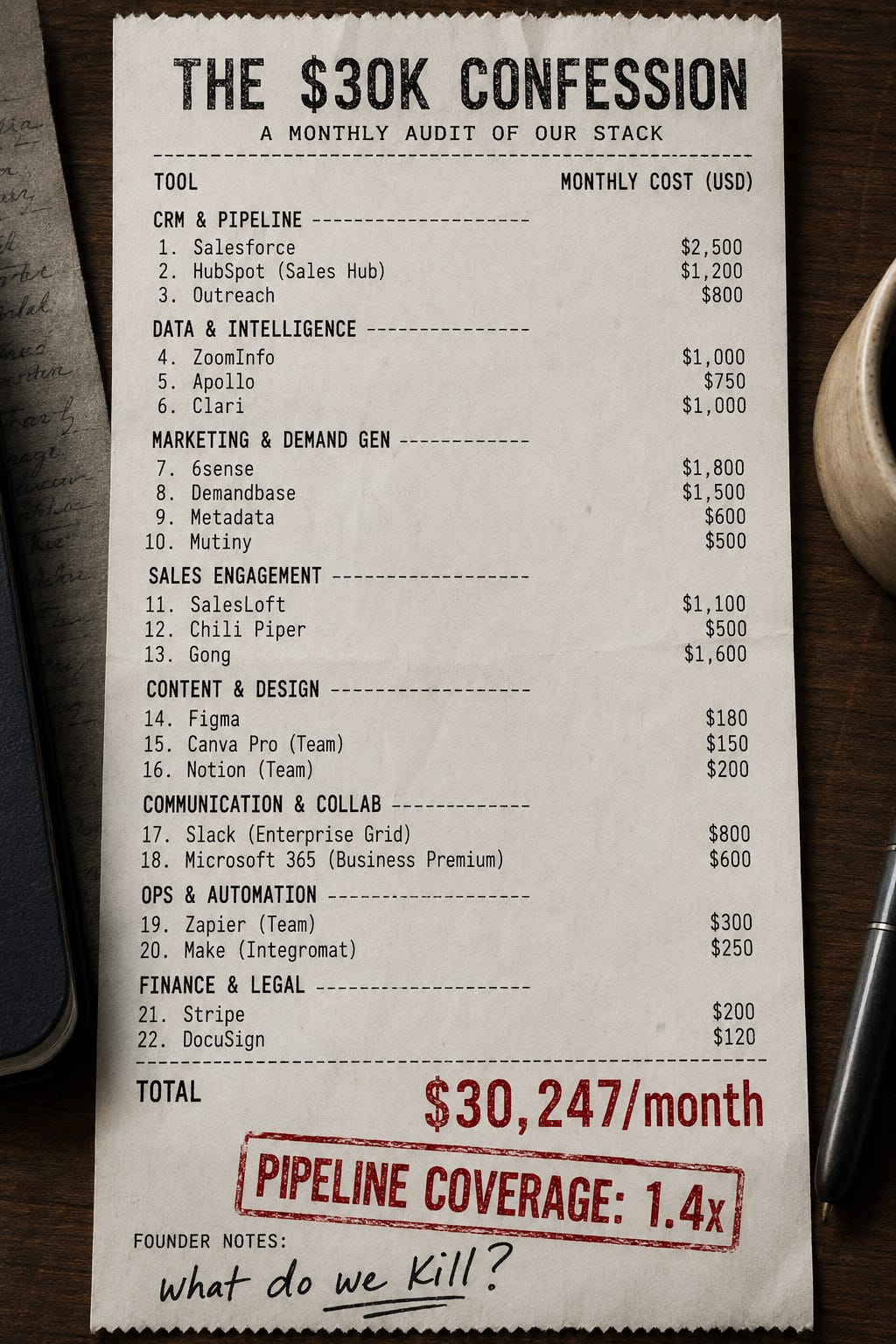
Last month, a Series A founder slid his GTM stack across a Notion page like it was a confession.
Twenty-two tools. About $30K a month in software.
A revenue team of nine humans quietly pretending it was all working.
Pipeline coverage sat at a thin 1.4x, not enough to hit the quarter, nowhere near enough to hit the year.
He asked me one question: “What do we kill?”
So I audited the whole thing.
Here’s the uncomfortable part, the tools weren’t actually the problem.
The default Series A playbook is “List → Sequence → Hope,” and it quietly dies somewhere around $3M ARR
You already know the pattern, because everyone is running it:
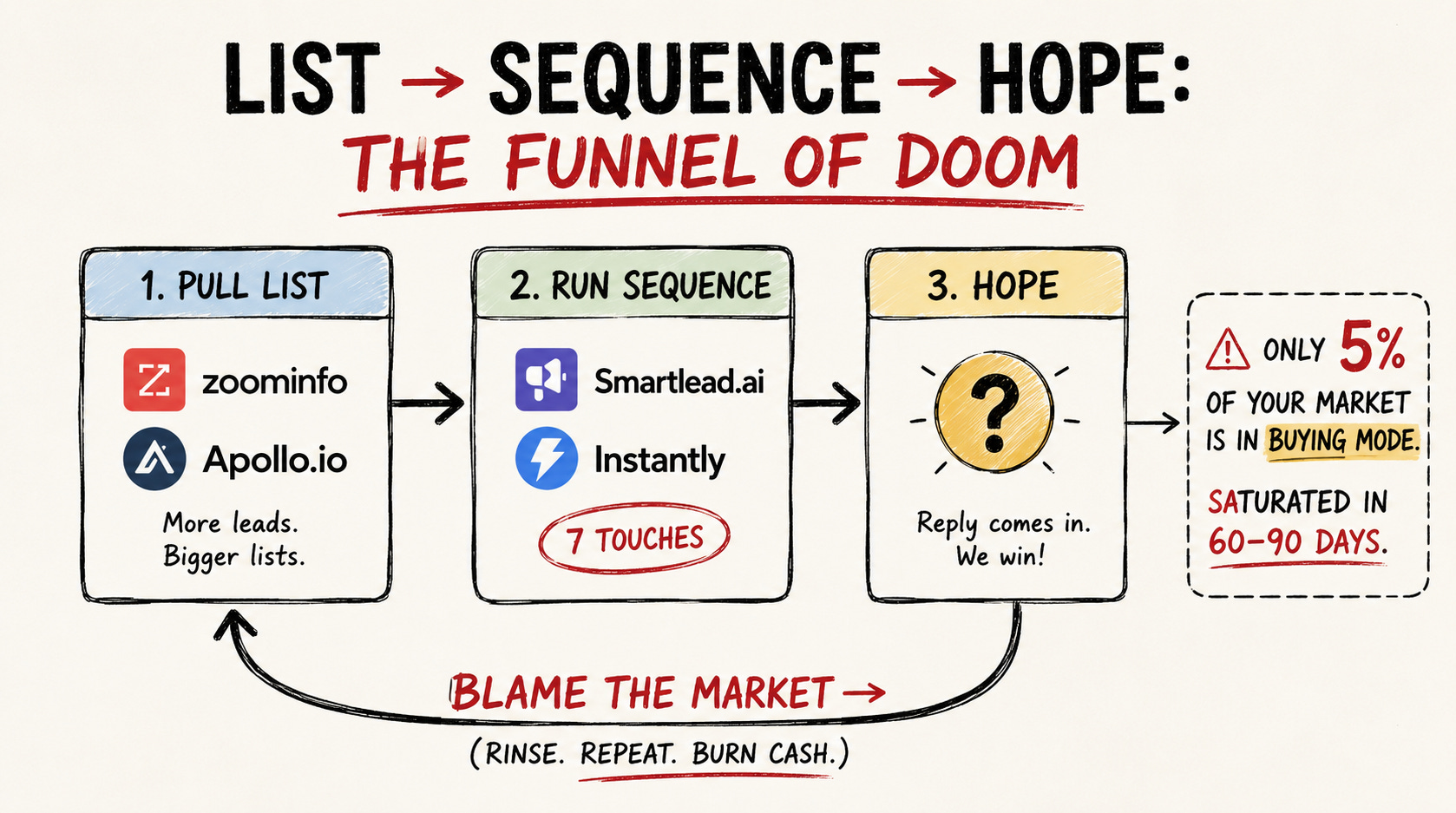
↳ Pull a list from ZoomInfo or Apollo
↳ Drop it into Smartlead or Instantly
↳ Run a 7-touch templated sequence with someone’s first name in the subject line
↳ Wait for replies
↳ Blame “the market” when none come
It works at seed. It plateaus hard at Series A.
The math is brutal, only 5% of your market is in buying mode at any moment.
You’ll burn through your in-market list in 60 to 90 days. After that, your beautiful $30K stack is just sending warm air to inboxes that already deleted you.
Tool sprawl is just the symptom; the missing signal layer is the actual disease
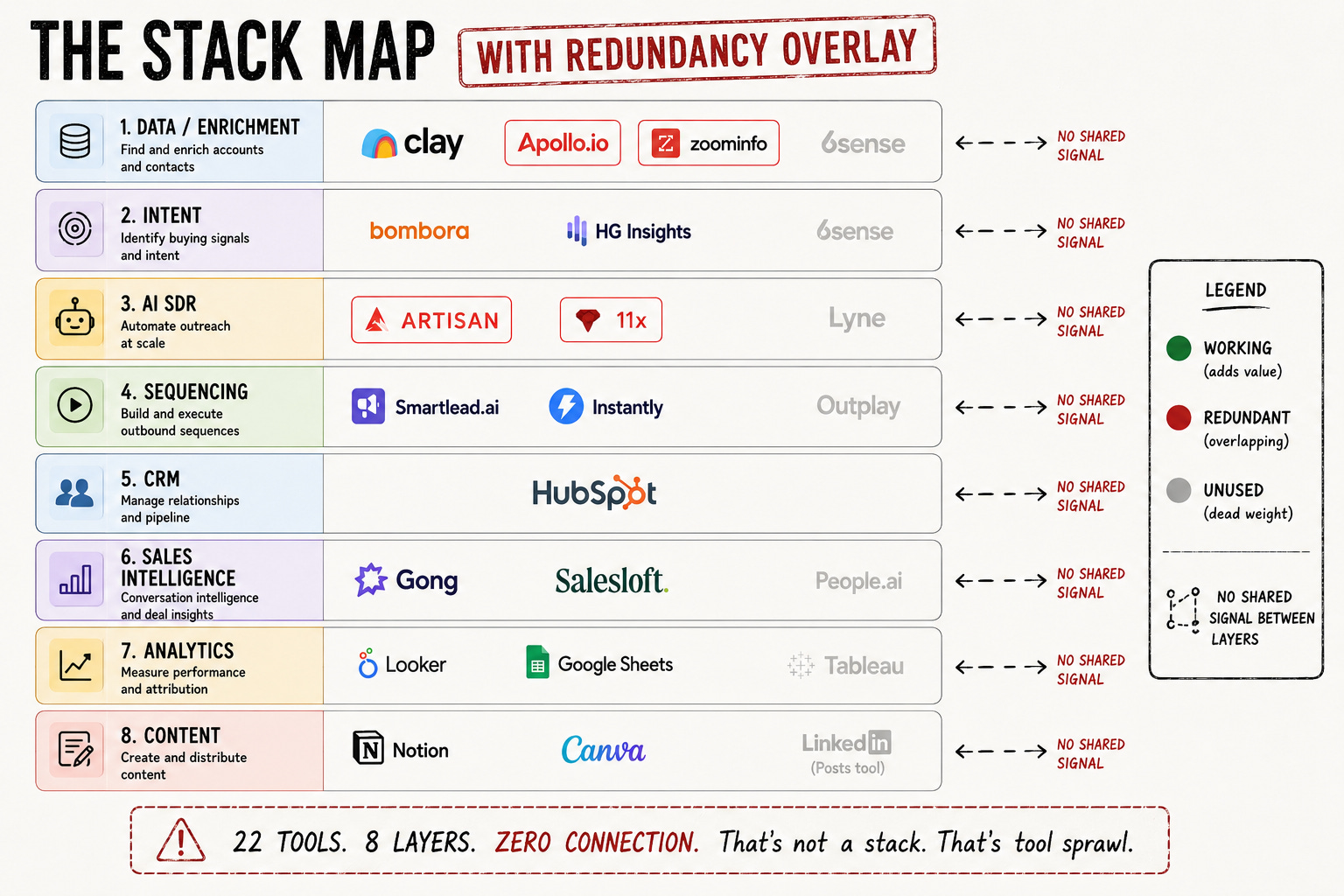
This is where the audit got fun, in a tragic-comedy kind of way. The stack had:
↳ Three enrichment tools doing overlapping work — Apollo, ZoomInfo, and Clay
↳ Two AI SDRs (Artisan and 11x) that had never been wired to the same ICP definition
↳ A 6sense subscription no one had logged into in three weeks
↳ A LinkedIn content engine running on autopilot, with zero social selling motion underneath
↳ HubSpot, Gong, and Salesloft — none of which were genuinely talking to each other
Nine humans. Twenty-two tools. Not a single shared definition of “qualified.”
That isn’t a tool problem. That’s an architectural problem wearing tool-shaped clothing.
Once you strip the noise, the parts actually pulling their weight become obvious
About a third of the stack deserved every dollar. The pattern was telling:
↳ Clay as connective tissue. Not another enrichment tool, the workflow brain pulling signals from Champify (job changes), UserGems (alumni movement), and Common Room (community activity) into one ICP-fit list.
↳ Signal-driven outbound on a small list. Not 5,000 prospects. Two hundred. Each tied to a real trigger, a new VP of Engineering, a layoff round, an earnings call mentioning their exact pain point.
↳ Founder-led enterprise multi-threading. The CEO personally working 5–8 person buying committees on six target accounts. That motion alone produced 40% of the pipeline.
↳ One Gong-fed feedback loop rewriting messaging weekly based on real objection patterns.
Four motions. That’s it. The other 70% of the stack was expensive decoration.
And here’s where the $30K a month was quietly going to die
This is the part of every audit where someone gets defensive about a tool they personally championed. The honest list:
↳ AI SDRs sending personalized-looking spam to prospects with zero signal underneath
↳ “ABM campaigns” that were really just retargeted LinkedIn ads with extra steps
↳ A thought-leadership content motion with no conversion path back to sales
↳ Intent data nobody read, because acting on it required a workflow no one had built
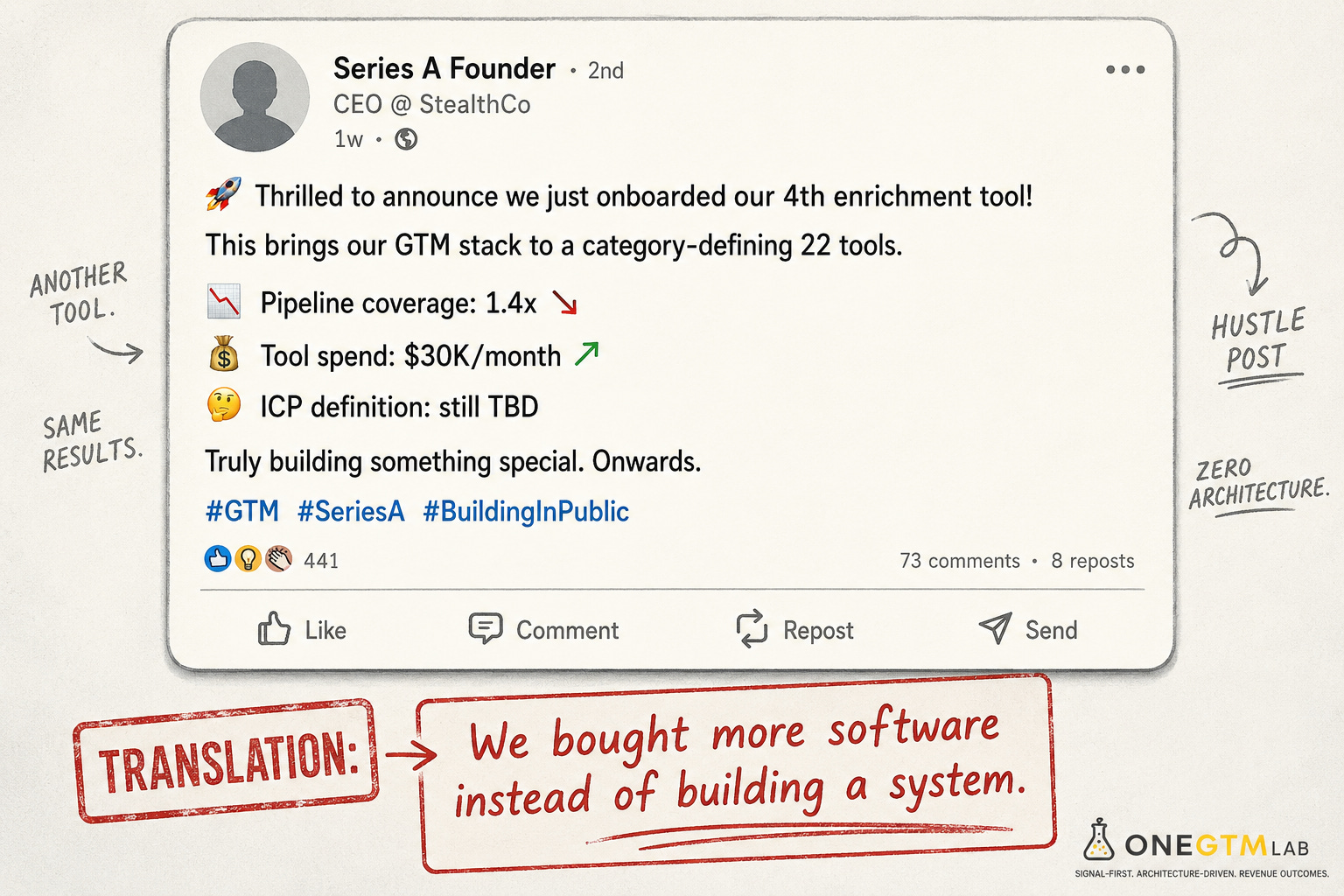
If your software bill is bigger than the revenue motion supporting it, you don’t have a GTM stack. You have a SaaS subscription habit.
The fix is never more tools — it’s the signal architecture sitting underneath them
Every working Series A GTM stack I’ve audited follows the same five-layer spine:
ICP → Signals → Timing → Relevance → System.
Tools sit on top of that spine. Without it, you’re just paying enterprise prices for spray-and-pray. With it, ten tools quietly outperform twenty.
The founder I audited cut his stack to nine tools and rebuilt the architecture. Pipeline coverage hit 3.2x in 90 days. Same team. Same market. Same product. Different system underneath.
If your Series A stack feels heavier than the pipeline it produces, this is your sign
I’m running a small batch of GTM stack audits over the next few weeks for Series A founders feeling exactly the plateau described above. If you want yours looked at — no pitch, just the audit — reply to this post or book a call me at.
The tools aren’t the problem. The system underneath them is.