
I Tested 100+ AI Tools
This 6-Stage GTM Stack With Tools Is All I Use Now

Six months ago, I found myself doing what most of us do when we hear “AI will change everything.”
I opened 20+ tabs.
Signed up for every shiny new tool.
Started “playing around” with AI for product marketing and GTM tasks.
At first, it felt productive.
But soon, I was overwhelmed.
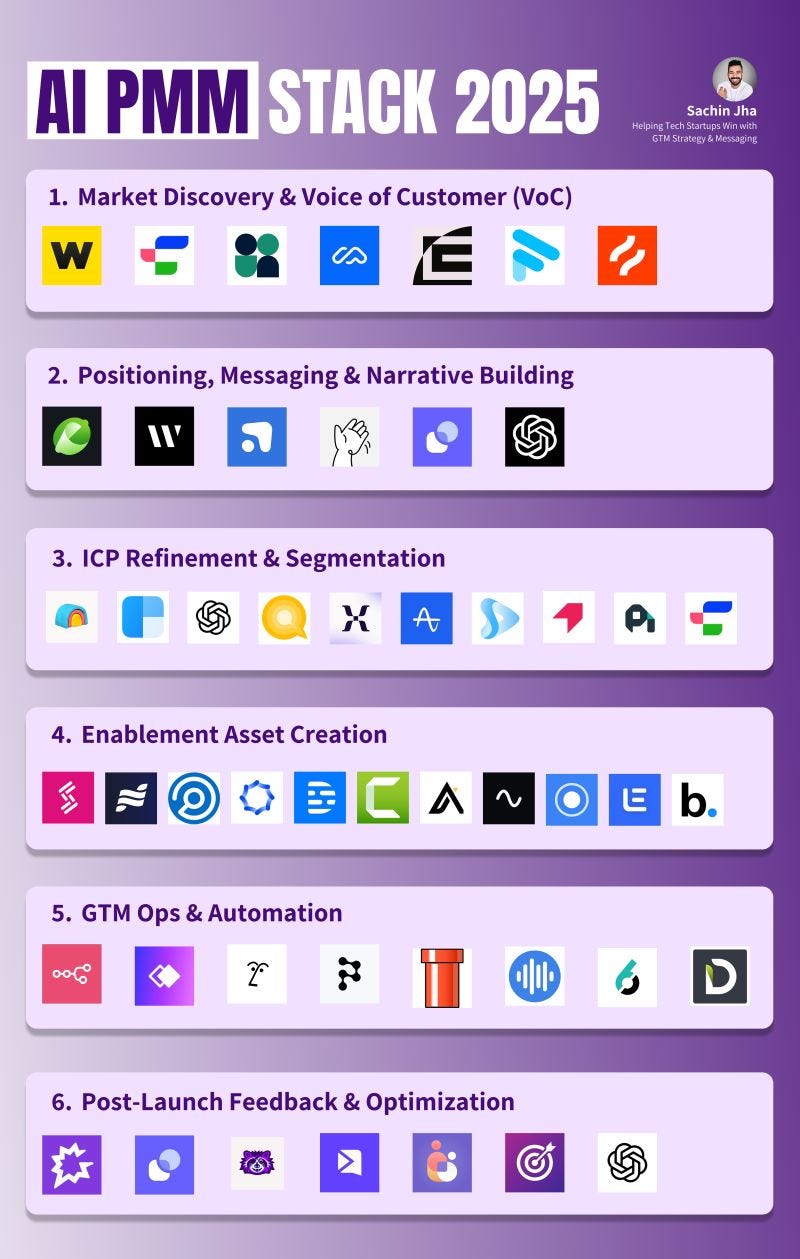
The Problem: The Stack Wasn’t the Strategy
I realized something simple but important:
Tools alone don’t make you better. A well-designed workflow does.
So instead of asking:
“What’s the best AI tool for messaging or research?”
I started asking:
“What part of the GTM process am I in right now? And what exactly do I need to get done?”
That changed everything.
I Broke My GTM Motion Into 6 Stages
This wasn’t about automation or AI hype anymore.
It was about structure—creating a repeatable way to move from idea → launch → optimization without reinventing the wheel every time.
Each stage became a focus area.
Each one served a different purpose.
And when connected, they formed a full-stack GTM engine.
Here’s how it works:
1. Market Discovery & Voice of Customer
Before building anything, I needed to deeply understand who I was building for and why it mattered.
This stage became all about extracting raw customer truth:
What are they struggling with?
What language do they use?
What do they really want — not what they say they want?
This step isn’t optional. It’s the foundation.
2. Positioning, Messaging & Narrative Building
Once I understood the customer, the next step was clarity:
How do I describe what we do in a way that sticks?
This stage is where AI became my strategist, not just my assistant.
It helped me test ideas, shape narratives, and find angles I hadn’t seen.
But it only worked because I had insights from the first stage.
Messaging is just noise if it isn’t rooted in truth.
3. ICP Refinement & Segmentation
I thought I knew my audience.
But here’s what I learned: A great message to the wrong segment still flops.
This stage was about precision:
Who are my best-fit buyers?
What signals tell me someone is ready to engage?
How do I tailor messaging based on micro-personas?
Refining your Ideal Customer Profile (ICP) is like sharpening the blade before the swing.
4. Enablement Asset Creation
You’ve done the thinking.
Now you need to make sure the rest of the team can sell it, support it, and speak it fluently.
This stage became about translation: turning insight into assets.
Sales decks. One-pagers. FAQs. Battlecards.
The goal? Everyone is on message, not just the PMM.
5. GTM Ops & Automation
I didn’t want to be the bottleneck anymore.
So I built systems:
Triggered workflows for research → content
Simple automation for competitive tracking
Dashboards that gave signal, not noise
This is the hidden layer: the infrastructure that keeps things moving, even when you're deep in other work.
6. Post-Launch Feedback & Optimization
Most teams launch and move on.
I wanted to learn faster.
This stage was about building a feedback loop:
What worked? What didn’t?
Where did users drop off?
What messaging got ignored?
Feedback isn’t just about improvement — it powers the next round of positioning.
The Takeaway
You don’t need more tools.
You need a workflow that compounds.
Each stage above isn’t just a task list.
It’s a decision point.
And when connected, it becomes a high-leverage system.
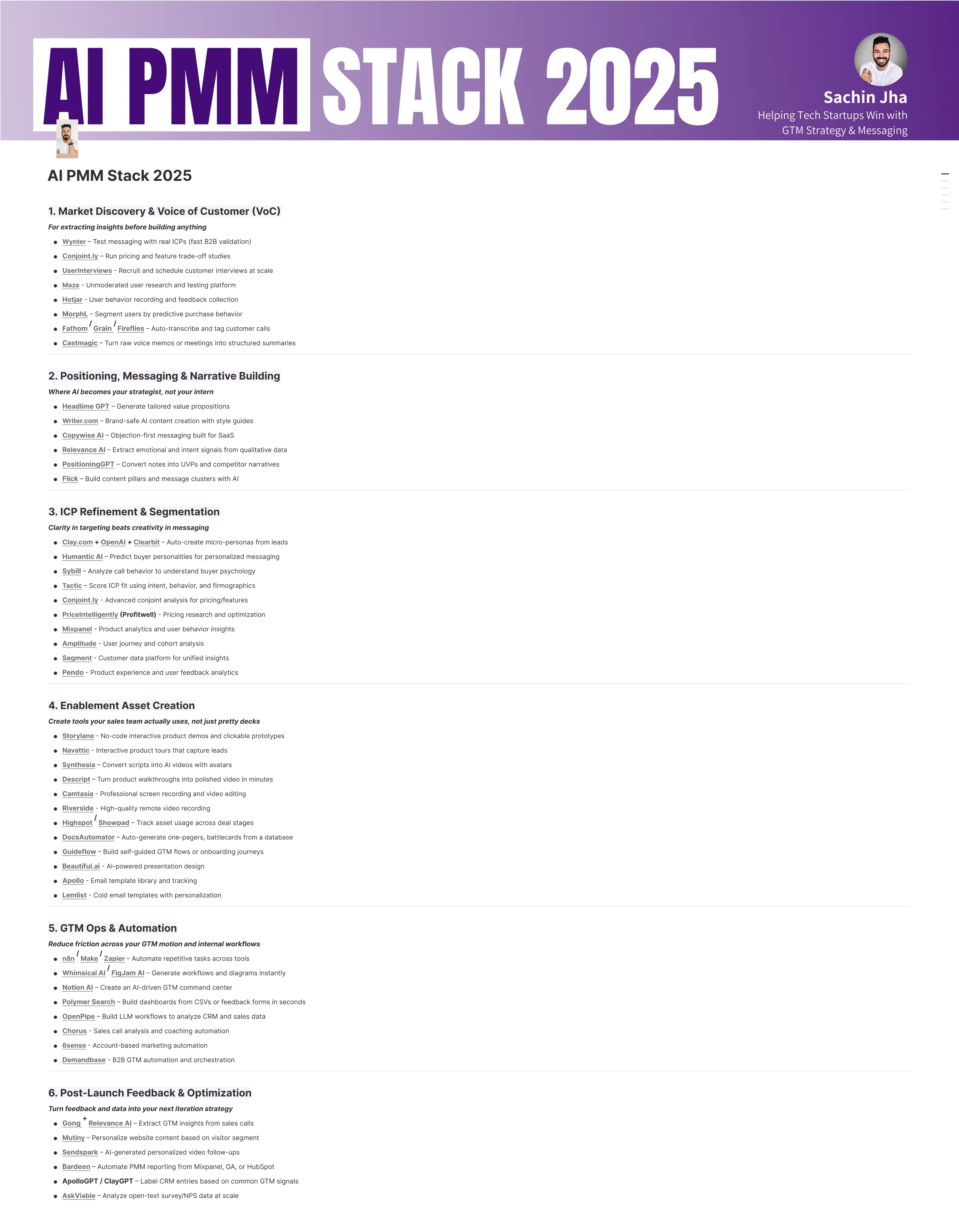
I mapped out this entire process into a Notion playbook:
→ Names of the tools with links
→ When and why to use them
→ How to combine them effectively
🔗 Here’s the playbook if you want it.
This changed how I work.
Might change how you do, too.