
The GTM Engineering Blueprint Cybersecurity Companies Actually Need In 2026
The complete six-layer system for sourcing, enriching, scoring, and activating the right cybersecurity accounts at exactly the right moment.

A quick note before we get into it: this article assumes you already understand the fundamentals of GTM. If you’re newer to the space, the 3 Layers of GTM series is a better starting point. What follows is tactical, system-level thinking built for practitioners who are ready to go deeper.
So let’s begin.
See! You need to understand that the cybersecurity buyer isn’t the average B2B buyer.
They’re buried in alerts. They have a stack of 40 tools they’re already managing. They get pitched by dozens of vendors a week. And they have zero patience for generic outbound that starts with “I noticed your company is in the security space.”
What actually cuts through? Specificity. Proof that you did your homework. A message that references something real about their environment.
To write that message, you need to know things about a company that aren’t in any standard database. You need to know their actual exposure. Their OSS dependencies. Whether their CISO just joined six months ago. Whether they posted three AppSec engineering roles last month. Whether they’re running tools that are mismatched to their current threat surface.
None of that lives in a standard lead list. All of it requires a system, and here’s the breakdown of that system.
The 6-Layer GTM Framework Walkthrough for Cybersecurity Companies
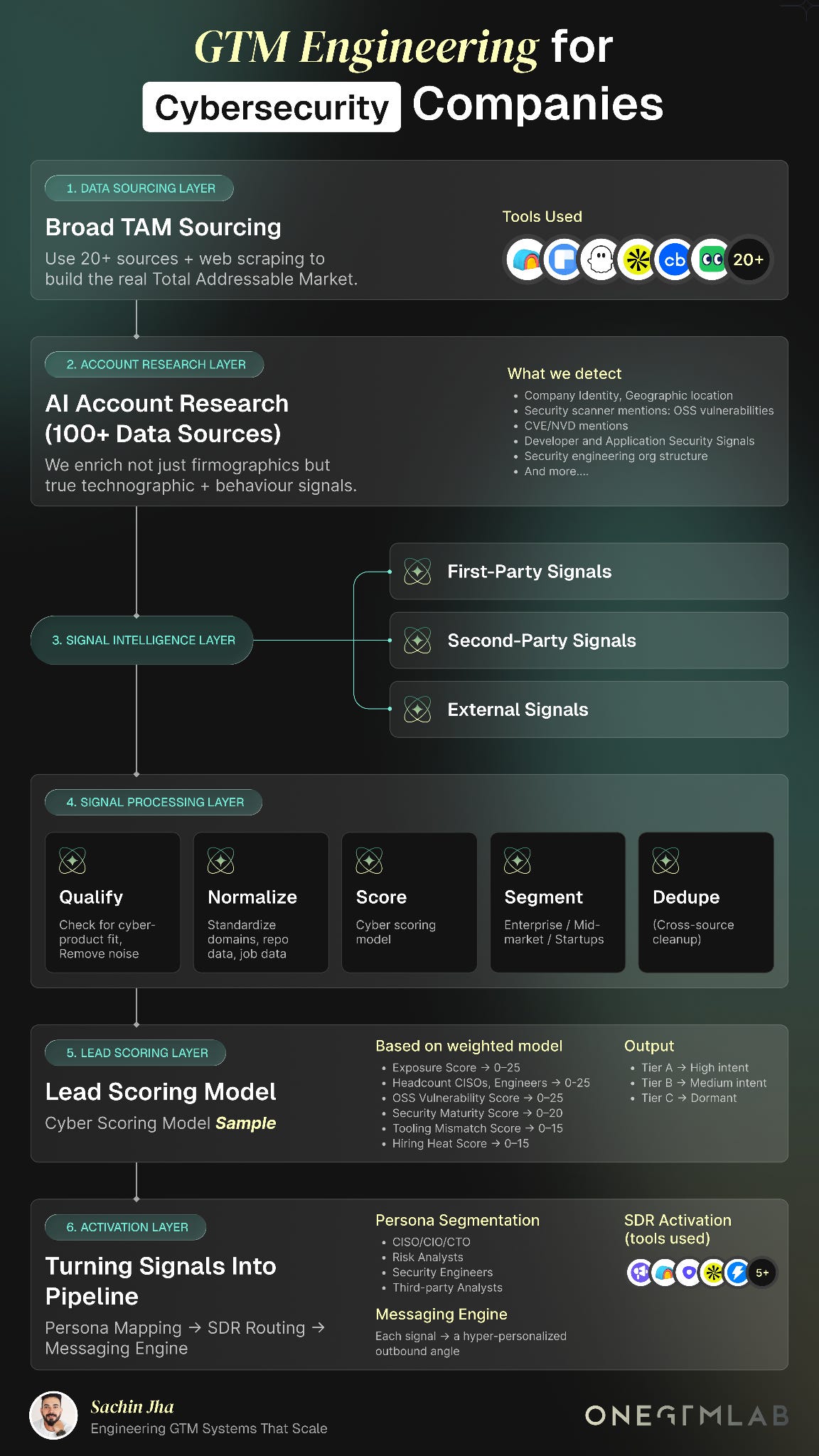
Grab a cup of coffee because we’re about to unpack each layer in a way that actually makes sense.
Layer 1: Build the Real TAM First
Most companies think they know their Total Addressable Market. Most are wrong.
A TAM isn’t a filtered export from one database. It’s a composite - pulled from 20 or more sources, cross-referenced, deduplicated, and verified. That’s what this layer does.
Tools you can use to build it:
Apollo.io for B2B contact sourcing at scale across 275M+ contacts
LinkedIn Sales Navigator for account mapping and buying committee discovery
Crunchbase for funding signals and company identity data
ZoomInfo for firmographic depth and enterprise intent data
BuiltWith for technographic data (what tools a company is currently running)
Beyond the standard stack, you also need to pull data from CVE/NVD databases, OSS repositories, security scanner directories, and job boards using custom web scraping. That’s where the 20+ sources number comes from.
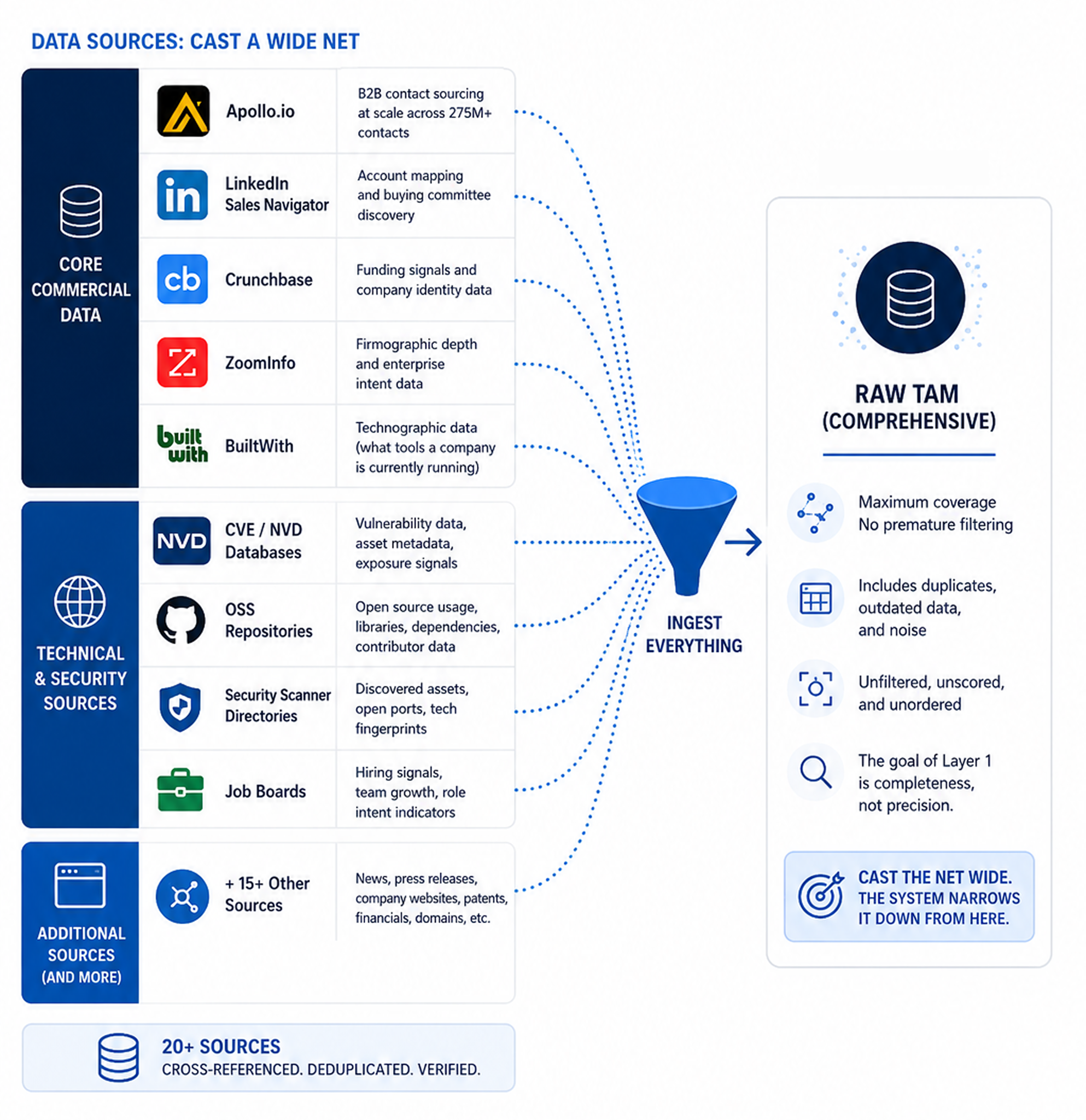
The output isn’t clean yet. It doesn’t need to be. The goal of Layer 1 is completeness, not precision. Cast the net wide. The system narrows it down from here.
Layer 2: Enrich With What Actually Matters
Firmographics tell you who a company is. This layer tells you what they’re dealing with.
Standard enrichment gives you headcount, revenue, industry, location. Useful. But not useful enough to personalise a security pitch.
Layer 2 goes deeper. Using AI-powered enrichment tools, you can pull:
Company identity and geographic location (basic, but confirmed across sources)
Security scanner mentions and OSS vulnerabilities, is this company’s code flagged in public databases?
CVE/NVD mentions, do their products or dependencies have known security holes?
Developer and application security signals, are their engineers publicly talking about security debt?
Security engineering org structure, how big is the team? Who runs it? When was the CISO hired?
Tools that you can use:
Clay (Claygent), it can act as your nerve center of this layer. Because, it pulls enrichment from 50+ sources simultaneously, runs AI research workflows, and appends behavioral and technographic data in a single table.
Common Room, can be used to aggregate community-level signals such as developer conversations, open source mentions, forum activity.
And you can let custom AI research agents handle CVE/NVD cross-referencing at a scale no human team could match.
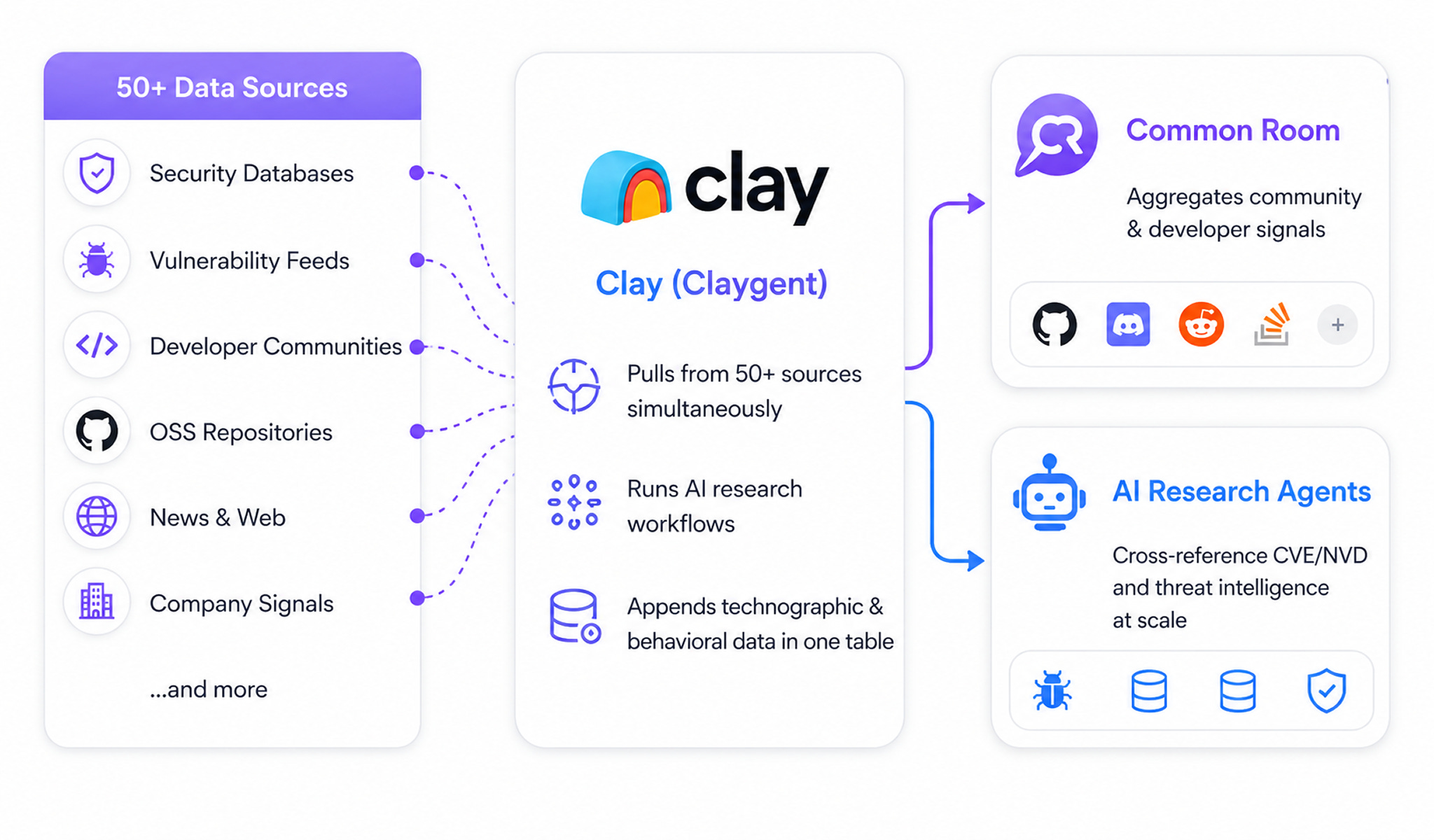
The principle is simple: enrich not just firmographics, but true technographic and behavioural signals. You’re trying to understand what a company’s actual security posture looks like from the outside.
Layer 3: Classify Every Signal Into Three Buckets
Not all signals are equal. This layer sorts them before any processing happens.
Once you have enriched accounts, you need to understand what kind of evidence you have on each one. You need to separate signals into three categories:
First-Party Signals → data you own. Someone visited your pricing page. A contact filled a form. A user triggered an in-product event. These are your warmest signals. Tools like HubSpot and Amplitude capture this.
Second-Party Signals → data shared by partners. Platforms like 6sense and Bombora run co-op intent networks where companies’ research behavior is aggregated and shared. If an account is actively researching “endpoint detection and response” right now, that’s a second-party signal.
External Signals → public data from the outside world. A company posted five CISO-level job openings this month. Their GitHub repo got flagged with a critical CVE. Their CIO just gave an interview about wanting to consolidate their security stack. These signals are publicly available, but you need a tactical to detect them at scale.
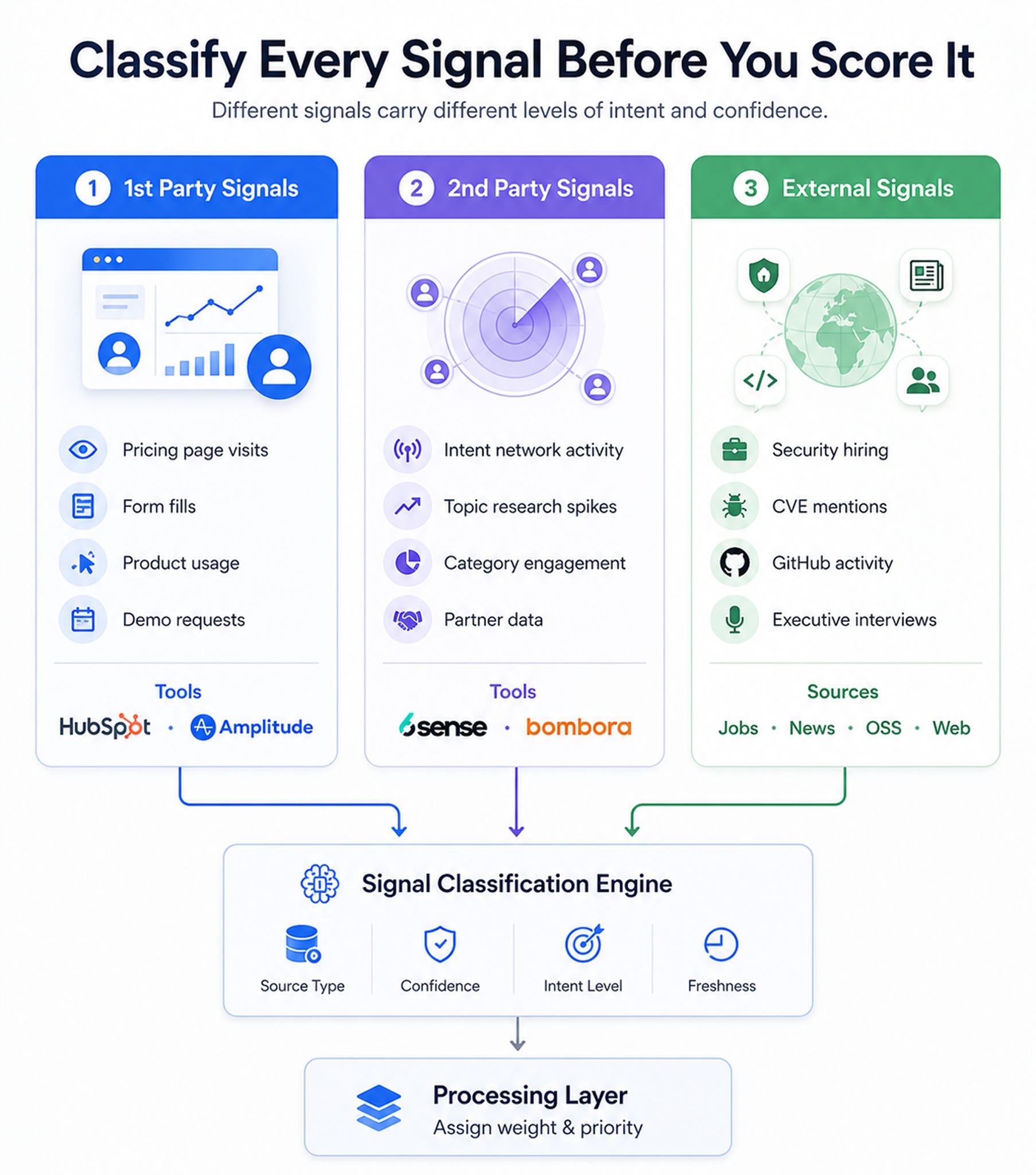
The goal of this layer isn’t to act on signals yet. It’s to classify them so the processing layer knows what weight to give each one.
Layer 4: Clean the Data Before It Poisons the Model
This is the layer most teams skip. It’s also the layer that breaks everything downstream if you ignore it.
Raw signal data from 20+ sources is messy. The same company might appear under three different domain formats. Job titles aren’t standardised. Funding data is dated. You have duplicates everywhere.
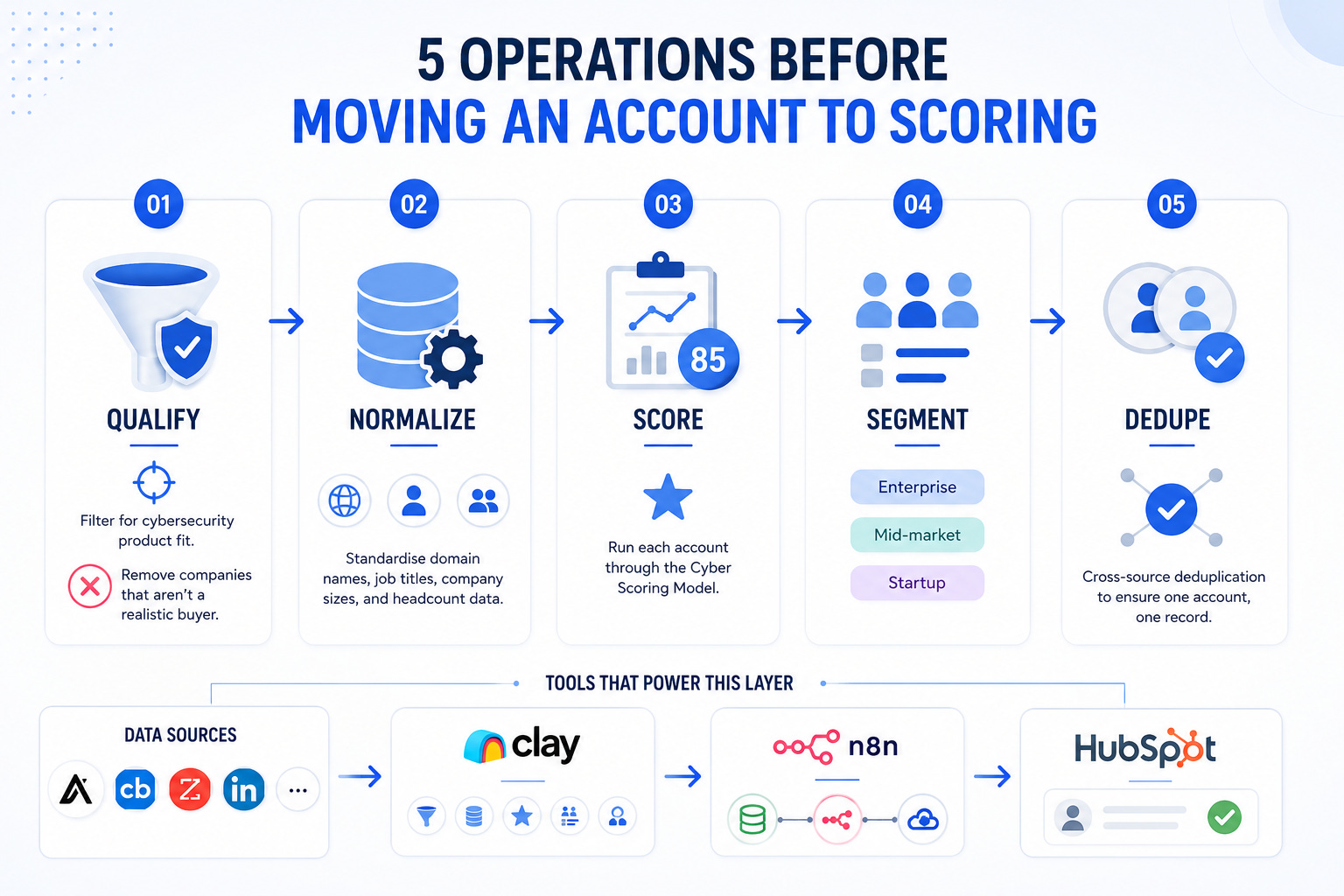
In layer 4, you need to run five operations before moving a single account to scoring:
Qualify → filter for cybersecurity product fit. Remove companies that aren’t a realistic buyer regardless of what signals they’re showing. Remove the noise.
Normalize → standardise domain names, job titles, company sizes, and headcount data so every account is comparable.
Score → run each account through the Cyber Scoring Model (more on this in Layer 5).
Segment → bucket accounts into Enterprise, Mid-market, and Startup. Each tier requires a different sales motion, different messaging, and different rep assignment.
Dedupe → cross-source deduplication. The same company can appear in Apollo, Crunchbase, ZoomInfo, and a LinkedIn scrape simultaneously. Dedupe ensures your SDRs aren’t calling the same account from four different queues.
Tools that handle this layer:
Clay runs all five sub-steps inside a unified workflow
n8n orchestrates the pipeline between data sources and the scoring model
HubSpot receives the cleaned, scored accounts and stores them in CRM
Layer 5: Score Every Account With a Cyber-Specific Model
This is where gut feel gets replaced with a weighted formula.
Generic lead scoring doesn’t work for cybersecurity. “Opened an email” and “visited the website” aren’t meaningful signals when your buyer is a CISO who has twelve vendors knocking every week.
The Cyber Scoring Model sample that you can run:
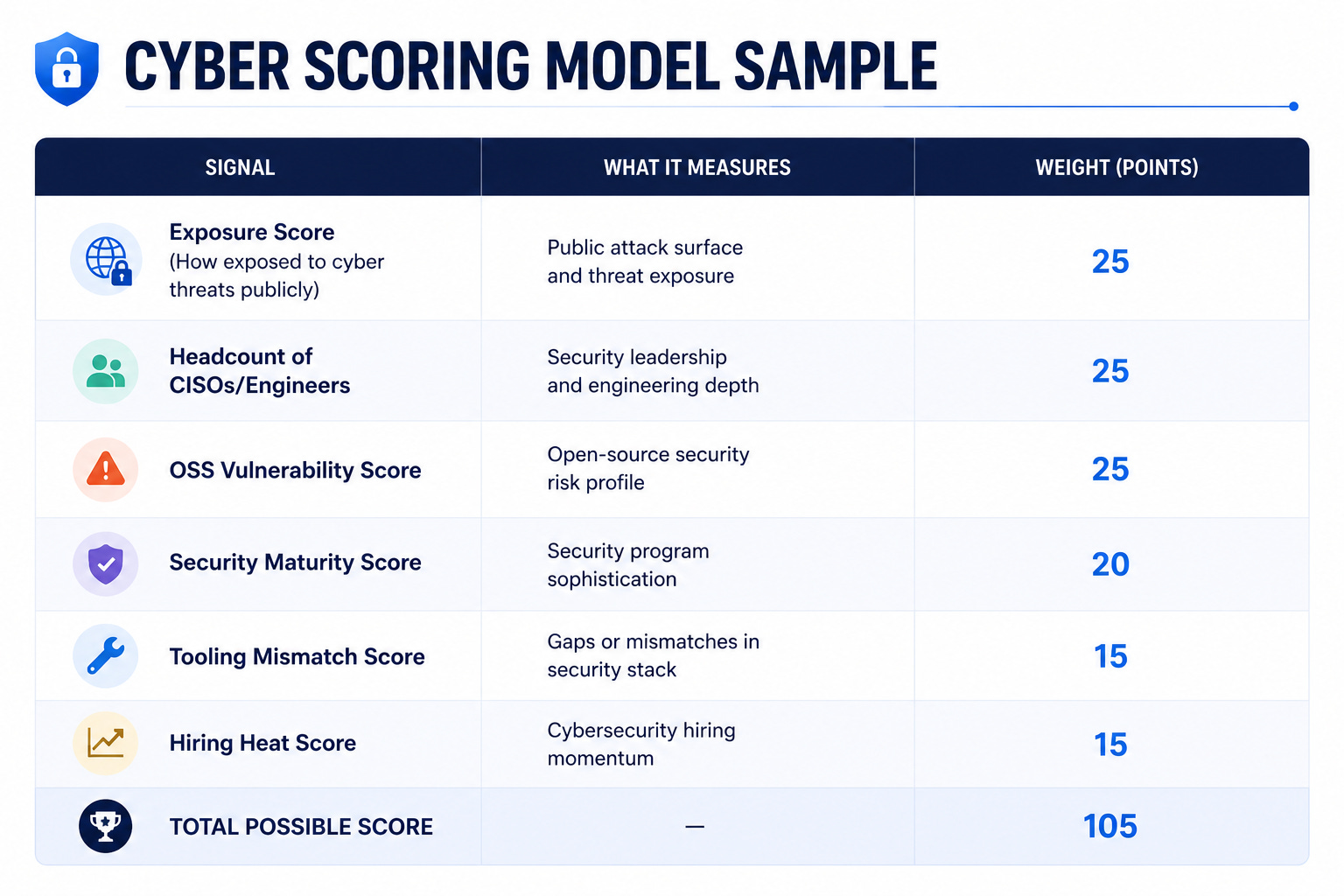
The weighting reflects something important: the highest-value signals in cybersecurity GTM aren’t behavioural (did they open your email). They’re situational (do they have real exposure and the team structure to do something about it).
Platforms like Bombora feed live intent data as an additional weight on top of the base score. An account already scoring 70 that’s also surging on “zero trust architecture” research moves up the queue faster.
The output is clean:
Tier A → High intent. Contact immediately.
Tier B → Medium intent. Enroll in nurture.
Tier C → Dormant. Park and monitor.
Tools: Clay (custom scoring columns), Bombora (intent weight), HubSpot (tier classification and routing).
Layer 6: Turn Scores Into Actual Conversations
All the data in the world is useless if the outreach doesn’t land.
Layer 6 is where the system pays off. Three things happen here.
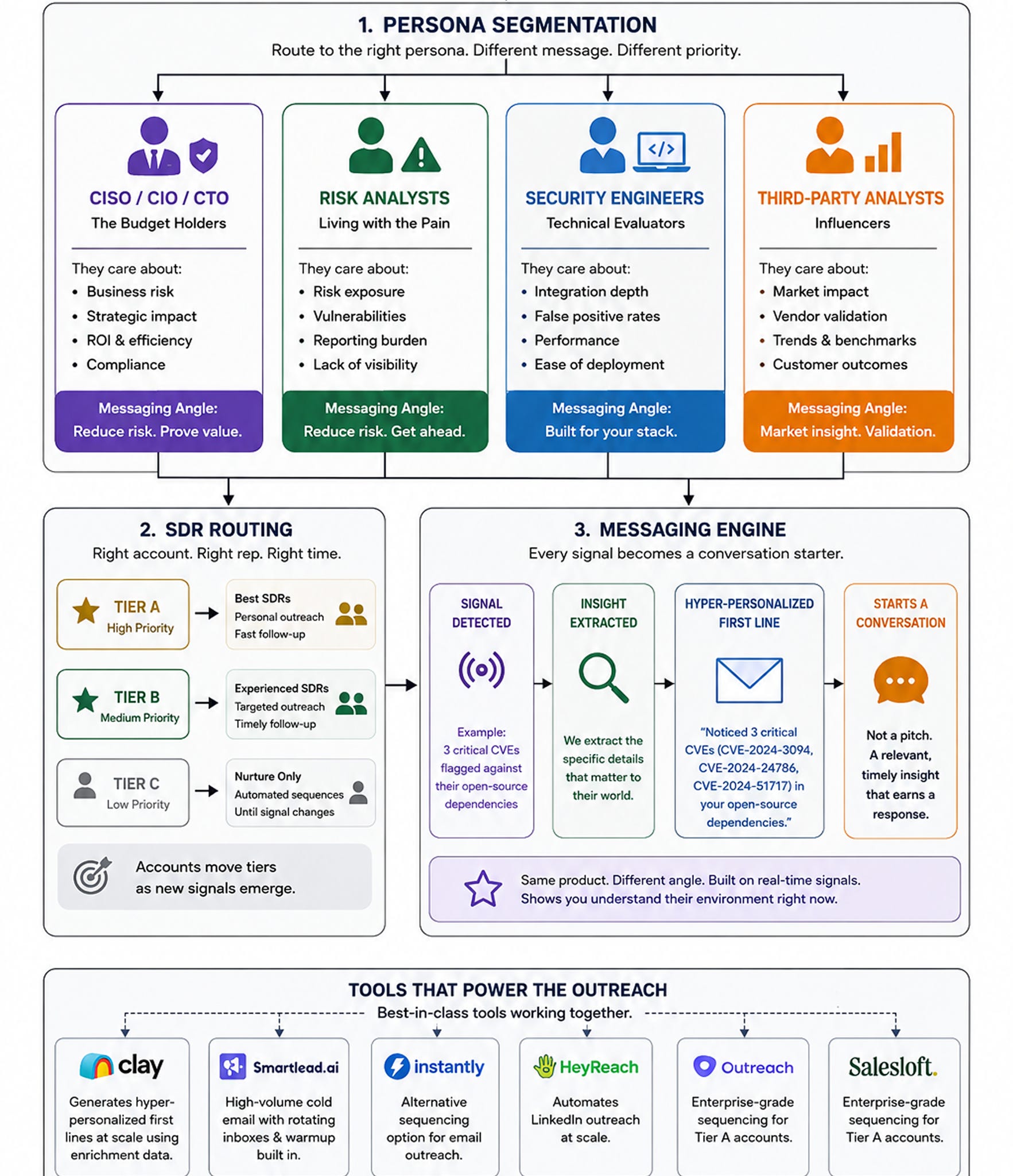
Persona Segmentation
Not everyone at a company is worth contacting. The need to route to four personas:
CISO/CIO/CTO → the budget holders
Risk Analysts → the people living with the pain daily
Security Engineers → the technical evaluators who will actually use the product
Third-party Analysts → influencers who shape internal decisions
Each persona gets different messaging. A CISO cares about business risk. A security engineer cares about integration depth and false positive rates. Same product. Different angles.
SDR Routing
You can use tools like HubSpot (or Salesforce at enterprise scale) to assign the right rep to each account. Tier A accounts go to your best SDRs. Tier C accounts don’t get touched until signals change.
Messaging Engine
This is where signal-based outreach becomes real.
Every signal generates a specific outreach angle. If the signal is “three critical CVEs flagged against their open-source dependencies,” the first line of the email references those specific CVEs — not a generic “I noticed you work in security” opener.
These tools can do the heavy lifting for you:
Clay generates hyper-personalised first lines at scale, pulling from the enrichment data already in the table
Smartlead handles high-volume cold email with rotating inboxes and warmup built in
Instantly is an alternative sequencing option for email outreach
HeyReach automates LinkedIn outreach at scale
Outreach or Salesloft for enterprise-grade sequencing on Tier A accounts
The principle: each signal becomes a conversation starter. Not a pitch. A demonstration that you actually understand what’s happening in their environment right now.
What This System Actually Produces
At the end of six layers, you don’t have a list of cold names. You have:
Accounts that match your ICP with verified technographic and behavioural data
Signals classified by type and weighted by relevance
A scored, tiered, segmented account universe
Personalised outreach angles tied to real environmental signals
SDRs talking to the right person with the right context at the right time
The difference between this and a standard outbound motion isn’t effort. It’s architecture.
Most cybersecurity GTM teams work hard. They pull lists, write sequences, hit send. The system described here doesn’t require more effort. It requires building the infrastructure once so that every subsequent outbound motion is operating on better information than your competitors have.
If this framework is useful, the infographic that maps the full system visually is worth saving. The architecture holds whether you’re selling endpoint security, SIEM, application security, or identity and access management. The layer logic stays the same. The signals just change.