
The Positioning Pivot That Saved Loom (And One That Didn't Save Clubhouse)
Two products. Same pandemic tailwind. One repositioned. One didn't. You already know how this ends.

You’ve built something people are using.
Maybe even talking about. But “talking about” isn’t converting, and “using” isn’t sticking.
Your messaging feels off, your ICP is blurry, and somewhere between your pitch deck and your homepage, the story broke.
This is a positioning problem. And it’s more common than founders admit.
Two of the most instructive case studies of the 2020s aren’t buried in a Harvard Business Review. They happened on your screen, in real time. One is Loom. The other is Clubhouse.
A Positioning Pivot Is Not What Most Founders Think It Is
It’s not a rebrand. It’s not a new logo or a softer tagline.
A positioning pivot means pulling one (or more) of these four levers:
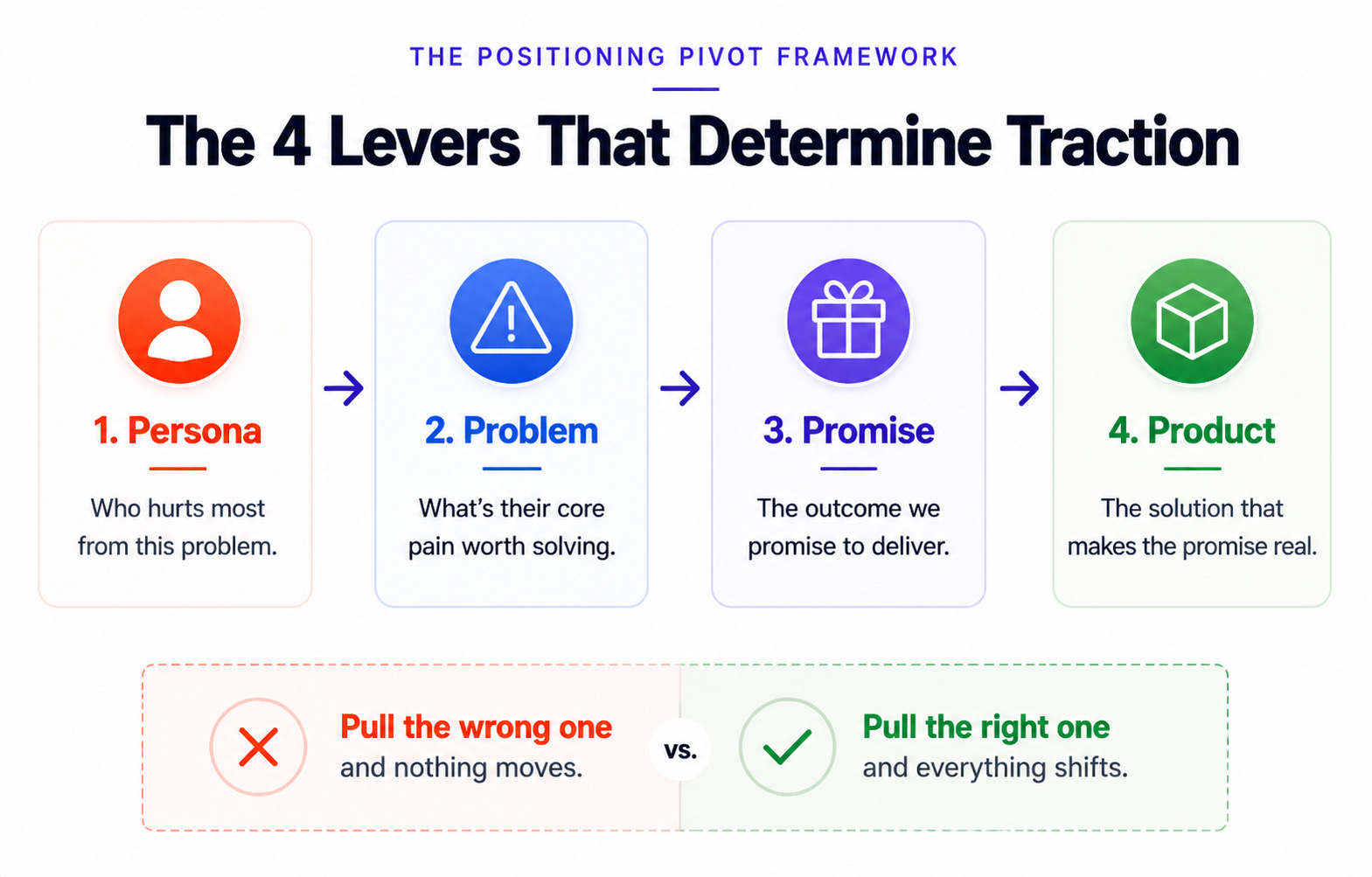
Most founders mistake a messaging tweak for a positioning pivot. They’re not the same thing. A tweak polishes the surface. A pivot changes the frame.
And that difference, between polishing and reframing, is exactly what separates Loom’s story from Clubhouse’s.
Loom Was Two Weeks from Dead Before It Found Its Real Market
Loom launched in 2015 as a lightweight screen recorder for developers.
→ Traction was minimal.
→ Credit cards were maxed.
→ The team was two weeks from running out of money.
Then something clicked.
They didn’t build a new product. They repositioned the one they had, away from “cool screen recorder for power users” toward something far more specific and far more valuable: async video for remote B2B teams.
Here’s what that pivot actually looked like:
→ Persona shift: From individual developers → to salespeople, marketers, and CS teams at companies
→ Promise shift: From “share your screen faster” → to “replace the meeting you didn’t need to have”
→ Product additions: Security, permissions, compliance, features only enterprise buyers care about
The co-founder Shahed Khan said it plainly: “Consumer behavior tends to lead enterprise behavior by two years.” They saw where the puck was going and skated there.
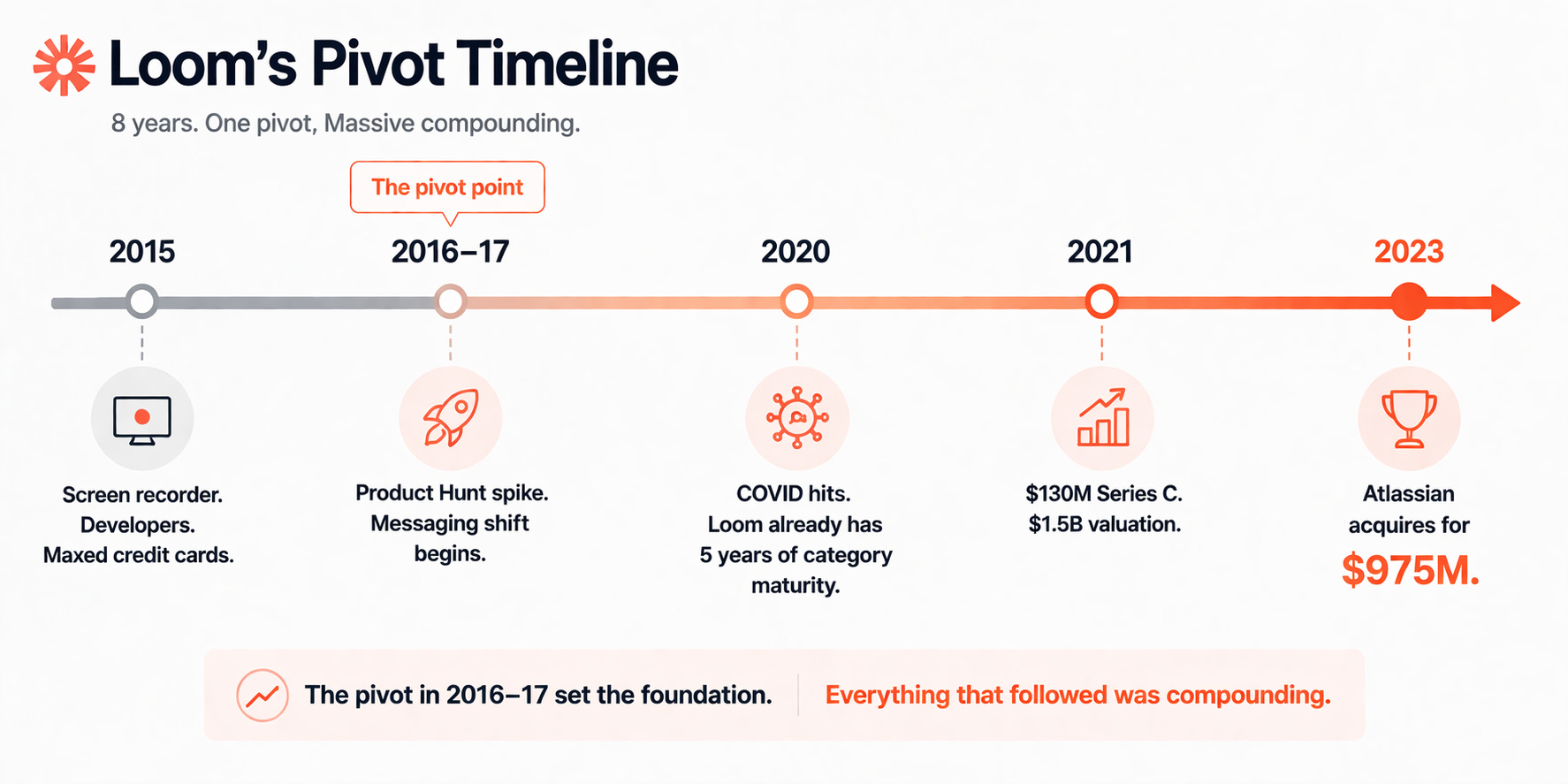
When COVID hit in 2020, Loom wasn’t scrambling to find a market. They had spent five years building category maturity. Every Loom video sent to a non-user was a product demo. Every recipient was a potential convert. By 2021, they closed a $130M Series C at a $1.5B valuation. In October 2023, Atlassian acquired them for $975 million.
Not bad for a team that once had maxed-out credit cards.
Now flip the lens. Same pandemic moment. Same tailwind. Completely different outcome.
Clubhouse Had 10 Million Users and Still Couldn’t Find a Reason to Exist
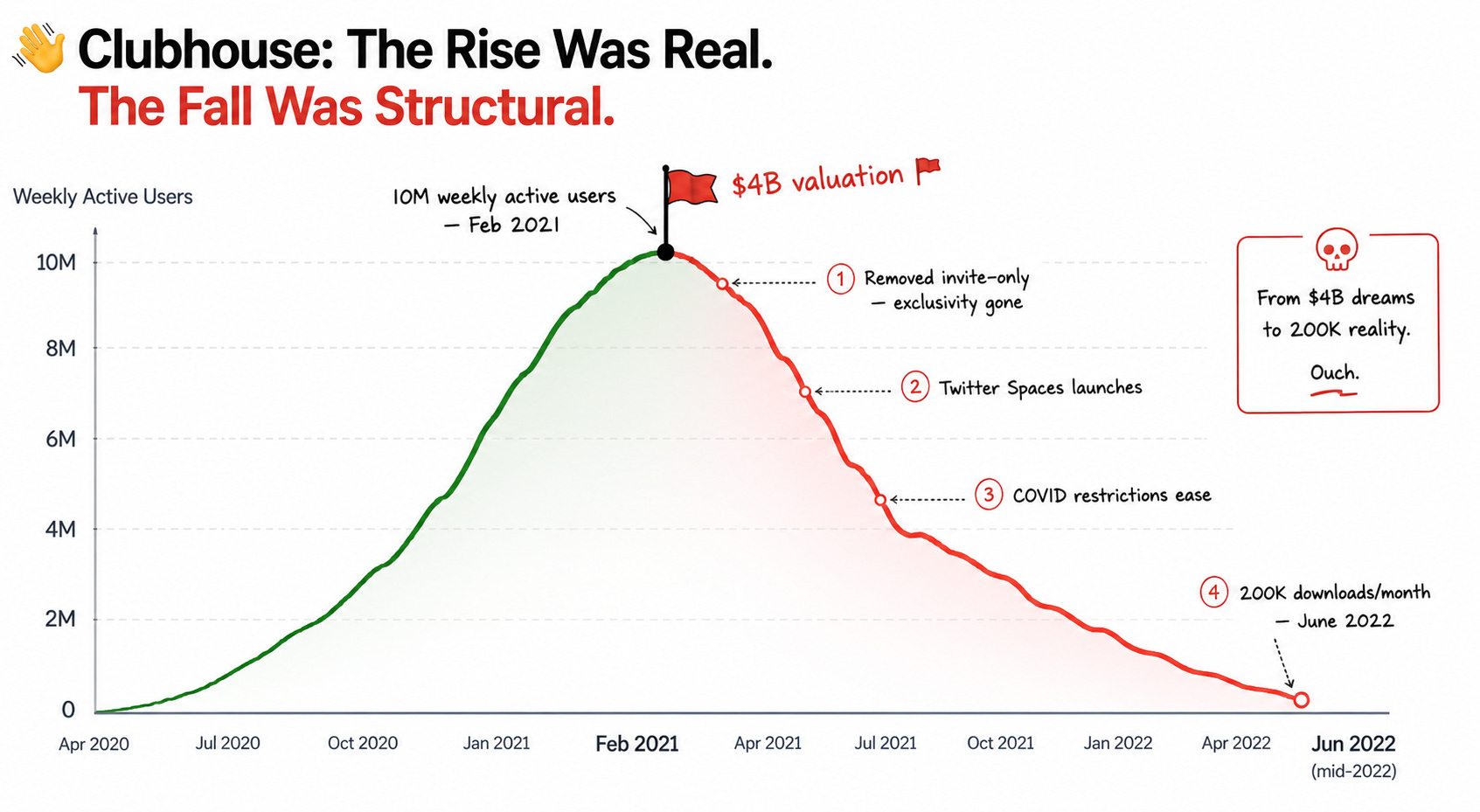
Clubhouse peaked at 10 million weekly active users in February 2021 and a $4 billion valuation.
Then it dropped over 90% from that peak. Downloads fell from 9.6 million in February 2021 to around 200,000 by mid-2022.
The product wasn’t bad. The positioning was structurally fragile, and they never fixed it.
Here’s the problem Clubhouse never solved:
→ The persona was a moment, not a market. Pandemic-isolated people craving connection isn’t an ICP. It’s a situation. Situations end.
→ The promise relied on exclusivity. Invite-only felt premium. When they opened it up, the magic evaporated, fast.
→ The product was synchronous in an async world. You had to show up at the right time to get value. That’s a brutal habit to sustain.
→ The pivot never happened. Twitter Spaces, LinkedIn Audio, Spotify, everyone cloned the feature in months. Clubhouse never repositioned to own a defensible problem, persona, or promise.
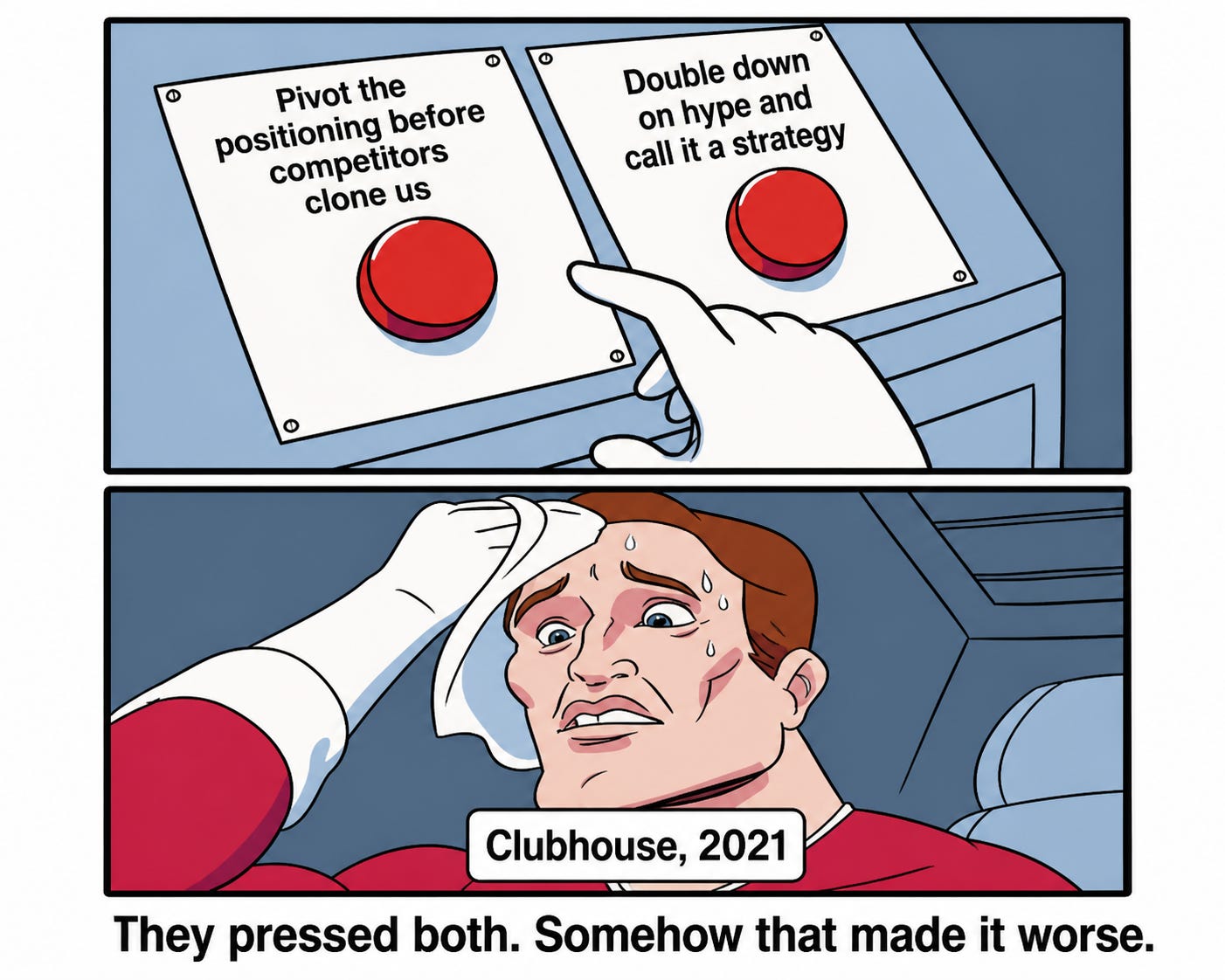
They doubled down on a leaky retention floor and called it growth.
So what was the actual separating factor? It comes down to one uncomfortable question.
The Real Question Is Whether Your Promise Outlives the Moment It Was Born In
Loom found a durable problem (async communication in distributed teams), committed to a specific persona (B2B teams at real companies), and built a promise that survived the pandemic context, because remote work didn’t go away.
Clubhouse found a viral moment, built an identity around it, and had no answer when the moment passed.
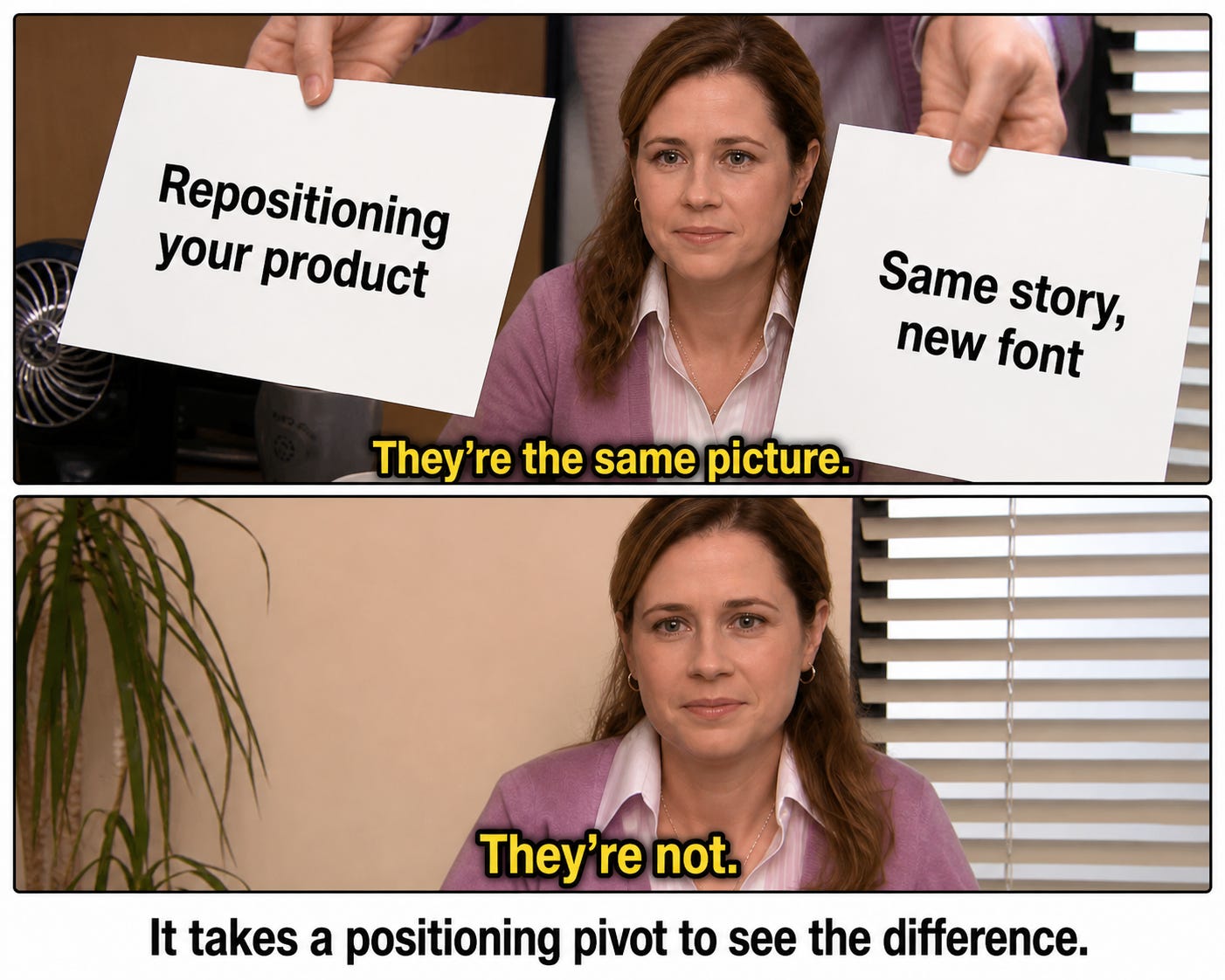
One pivot was pulled with intention. The other was never pulled at all.
Your Positioning Is Either Working for You or Quietly Working Against You
If your messaging isn’t converting, ask yourself honestly:
→ Is my promise solving a persistent pain, or a situational one?
→ Is my persona a real buyer profile, or a demographic feeling?
→ Am I repositioning, or just rewriting the same broken story in a new font?
Positioning isn’t something you do once at launch. It’s something you actively tend — or it drifts toward the loudest competitor who’s willing to own it instead.
Building your GTM positioning and not sure where to start? I work with B2B SaaS founders on exactly this signal-driven ICP work, positioning pivots, and the GTM systems that make it all compound. Book a call with me and let’s figure out what lever needs pulling.