
Your GTM Might Be Smart, But Still Totally Out of Sync with Buyer Intent
AI products, fast releases, and why sequencing your GTM matters more than ever

I’ve seen too many smart teams do all the right things, just at the wrong time.
Shipping thought leadership to buyers who just want a pricing page
Pushing case studies before the buyer even admits they have a problem
Building beautiful nurture sequences for audiences that aren’t even aware they need you
The result?
Confused buyers.
Bloated funnels.
Deals that go dark.
And it’s worse in AI where the speed of shipping has outpaced the speed of trust.
GTM for AI Products = A Different Beast
Too often, teams are executing feature-led launches when the market still needs category education.
Or they’re trying to “capture demand” in a space where intent hasn’t even formed.
That’s where most AI GTM fails.
Why?
Because they assume the buyer is ready.
Trust me, they’re not.
So what is the buyer ready for?
Let’s break it down using a simple mental model:
The 3 Intent Levels of GTM.
This isn’t about MQLs or funnel stages.
It’s about meeting buyers where they actually are: mentally, emotionally, strategically.
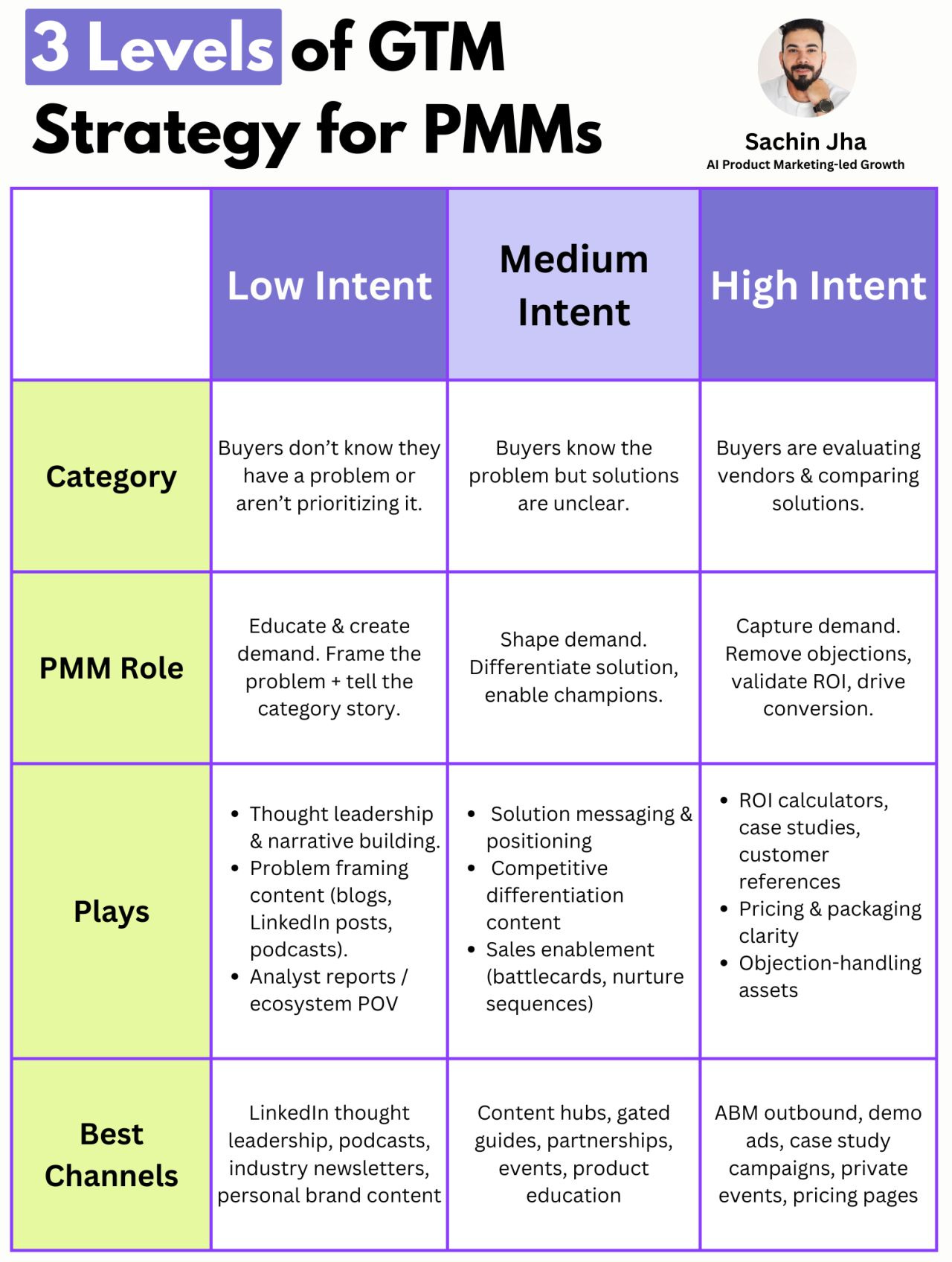
1. Low Intent: “I don’t even know I have a problem.”
This is the default state for many AI buyers today.
They’re intrigued. They’ve seen the hype.
But they haven’t yet felt the urgency to act.
They’re not on G2. They’re not evaluating vendors.
They’re still doing things manually or with old-school tools.
Your job here isn’t to sell. It’s to wake them up.
Product Marketer’s Role:
Frame the problem
Tell the category story
Help them see what’s broken in their current workflow
What works:
POV content
Problem-framing blogs
LinkedIn posts with founder takes
Analyst insights & ecosystem POV
🎙️ AI products especially need this because your buyer doesn’t always realize there’s a better way yet.
2. Medium Intent: “I get the problem… now who do I trust?”
These buyers feel the pain.
But they’re drowning in choices.
One AI tool claims “autonomous workflows.”
Another promises “human-in-the-loop.”
Everyone has a cool demo. No one has clear messaging.
Your job now is to clarify and differentiate.
Not against everyone just enough for your champion to make a case internally.
Product Marketer’s Role:
Sharpen positioning
Help your champion sell internally
Create competitive clarity
What works:
Solution messaging + battlecards
Gated guides, product webinars
Content hubs with real use cases
Nurture sequences that educate, not just promote
⚙️ This is where the real GTM engine kicks in you’re giving your buyer the ammo they need to fight for you.
3. High Intent: “Just show me this won’t backfire.”
At this point, they’re choosing.
They’ve got a shortlist. You’re on it.
But the real question isn’t “Are you good?”
It’s:
“Can I make this decision without looking stupid or putting my team at risk?”
Product Marketer’s Role:
Provide ROI proof
Preempt objections
Build confidence in the decision
What works:
ROI calculators, TCO breakdowns
Reference calls, case studies, customer logos
Objection-handling sheets
Executive alignment calls, private demo flows
🏁 The best AI products lose here not because of capability but because they didn’t address trust.
Punchline:
Product Marketing isn’t just about writing the story.
It’s about sequencing it matching message to mindset.
If you drop high-intent content at a low-intent moment, buyers tune out.
If you stay in problem-education mode when buyers are ready to choose, you stall the sale.
Sequence = Conversion
Intent = Timing
Timing = Revenue
And this matters more in AI than anywhere else because velocity can backfire when you’re not aligned with where the market actually is.
So if you’re GTM’ing an AI product right now, ask:
Are we educating or selling too soon?
Are we helping our buyers get internal buy-in?
Are we showing proof or just pushing hype?
Are we sequencing content across intent or spamming the same pitch to everyone?
The best GTM isn’t louder.
It’s smarter about when and where to show up.
📌 Save this if your AI product is shipping faster than your funnel can keep up.
Forward it to a founder or Product Marketer trying to figure out why “nobody’s converting.”
Let’s make GTM work with your buyer’s brain not just your launch calendar.